Tell us about the job
Takes about a minute. No obligation.
Gas-fired water heaters require a flue path and a source of combustion air, and both have to be confirmed before a contractor can commit to a replacement unit. Utility gas heats more occupied homes in Warren County, New Jersey than any other fuel, at 50.0% (2020-2024 ACS 5-year). That majority means most homes here already carry gas infrastructure, but the condition of the existing vent, its diameter, its termination point, and whether the space around the heater draws in enough fresh air all have to be checked. A mismatched vent on a new high-efficiency unit will fail inspection. The contractor prices the appliance last, after the flue and the combustion air supply are known.
Existing venting and plumbing runs decide how a water heater installation goes in much of Warren County's housing stock, and those runs were laid out for equipment that is long gone. Half the homes in Warren County, New Jersey were built in 1972 or earlier (2020-2024 ACS 5-year). A contractor quoting a new unit here checks whether the flue path, the supply lines, and the space around the heater suit what is being installed now, not what the house was originally built around. If they do not, the quote changes.
The Parts of a Water Heater an Installation Covers
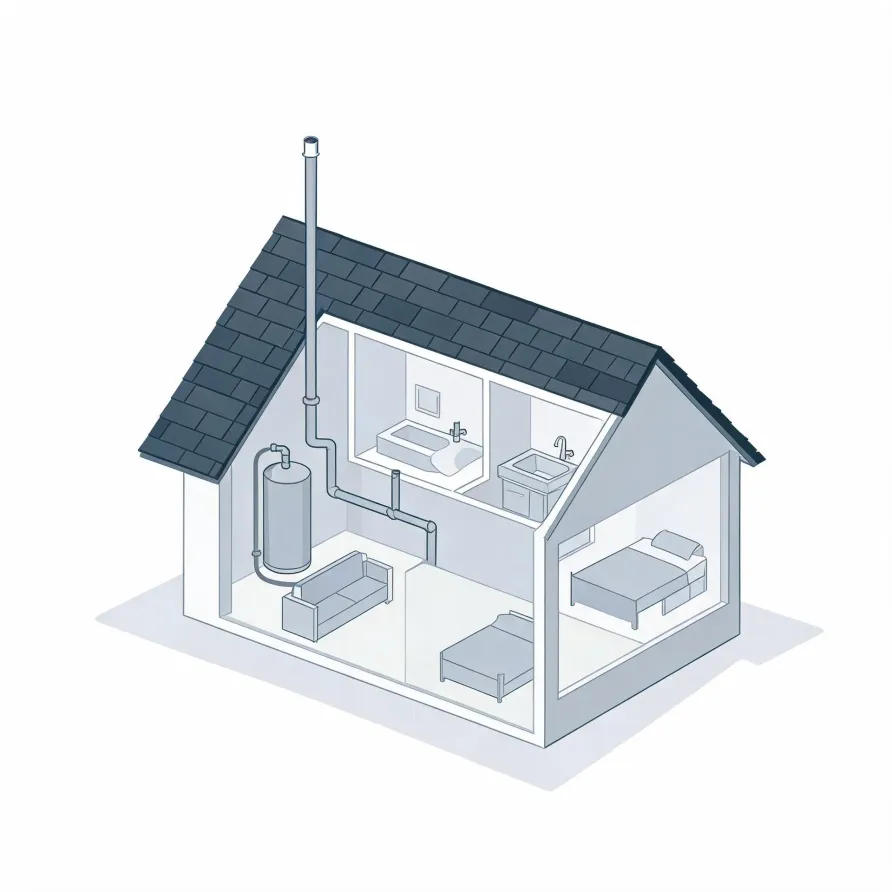
The tank is the piece a homeowner notices first. It sits in a utility space, basement, or closet and holds the water that gets heated for use throughout the house. Attached to the tank is the burner assembly or heating element, depending on the fuel source, which does the actual work of raising water temperature.
The pressure relief valve mounts directly on the tank and opens if pressure inside builds past a safe point. A discharge pipe runs from that valve down toward a drain. The cold water inlet and hot water outlet pipes connect at the top of the tank, and a shutoff valve sits on the cold side to let a contractor isolate the unit.
The drawing shows a typical layout, and a licensed contractor determines what applies to the specific setup in your home.
Get matched in Warren CountyWarren County, NJ, by the numbers
199 severe weather events were recorded in Warren County, New Jersey between 2015 and 2024.
NOAA National Centers for Environmental Information, Storm Events Database, bulk CSV export, events 2015-01-01 through 2024-12-31.Half the homes in Warren County, New Jersey were built in 1972 or earlier (2020-2024 ACS 5-year).
U.S. Census Bureau, 2020-2024 American Community Survey 5-Year EstimatesWarren County, New Jersey holds 46,789 housing units (2020-2024 ACS 5-year).
U.S. Census Bureau, 2020-2024 American Community Survey 5-Year EstimatesOwners occupy 75.1% of the occupied homes in Warren County, New Jersey (2020-2024 ACS 5-year).
U.S. Census Bureau, 2020-2024 American Community Survey 5-Year EstimatesCodes & Standards Governing Water Heater Installation in Warren County, New Jersey2 sourced rules and standards
Licensing and Legal Requirements in Warren County, New Jersey
In New Jersey the HVACR licence is the State's alone: a municipality, local board of health or any other agency may not issue or renew a Master HVACR contractor's licence.
New Jersey requires a Master HVACR contractor licence: no person or business may engage in the business of HVACR contracting, or advertise as a Master HVACR contractor, without being authorised under the State HVACR Contracting License Law.
Severe Weather Events in Warren County
Extreme weather puts real strain on water heaters, which work harder to recover when temperatures swing and demand spikes. How much of that strain a unit in Warren County absorbs over its life is a local question, and the record below reflects the conditions contractors here plan around.
199 severe weather events, 2015–2024. Source: NOAA National Centers for Environmental Information, Storm Events Database.