Tell us about the job
Takes about a minute. No obligation.
Gas-fired water heaters run their burner and ignition systems hard, and in Bergen County that load is the norm rather than the exception. Utility gas heats more occupied homes in Bergen County, New Jersey than any other fuel, at 76.9% (2020-2024 ACS 5-year). A contractor called out for a failing unit here starts at the burner assembly, the thermocouple, and the gas valve, because those are the parts the combustion cycle degrades first. Venting condition follows, since a gas appliance that has been running for years accumulates residue that a visual check on the exterior will not catch.
Sediment buildup and anode depletion are what decide how a water heater repair actually goes in Bergen County housing, and neither shows from the outside. Half the homes in Bergen County, New Jersey were built in 1960 or earlier (2020-2024 ACS 5-year). A tank that has been cycling through hard-water mineral deposits for that long accumulates a floor of sediment that reduces heating efficiency and accelerates tank wall corrosion from the inside. When a contractor opens the system, what matters is whether the anode rod has any material left and whether the tank lining is still intact, because those two conditions together determine whether repair is viable or replacement is the only answer that holds.
The Parts of a Water Heater a Contractor Checks During a Repair
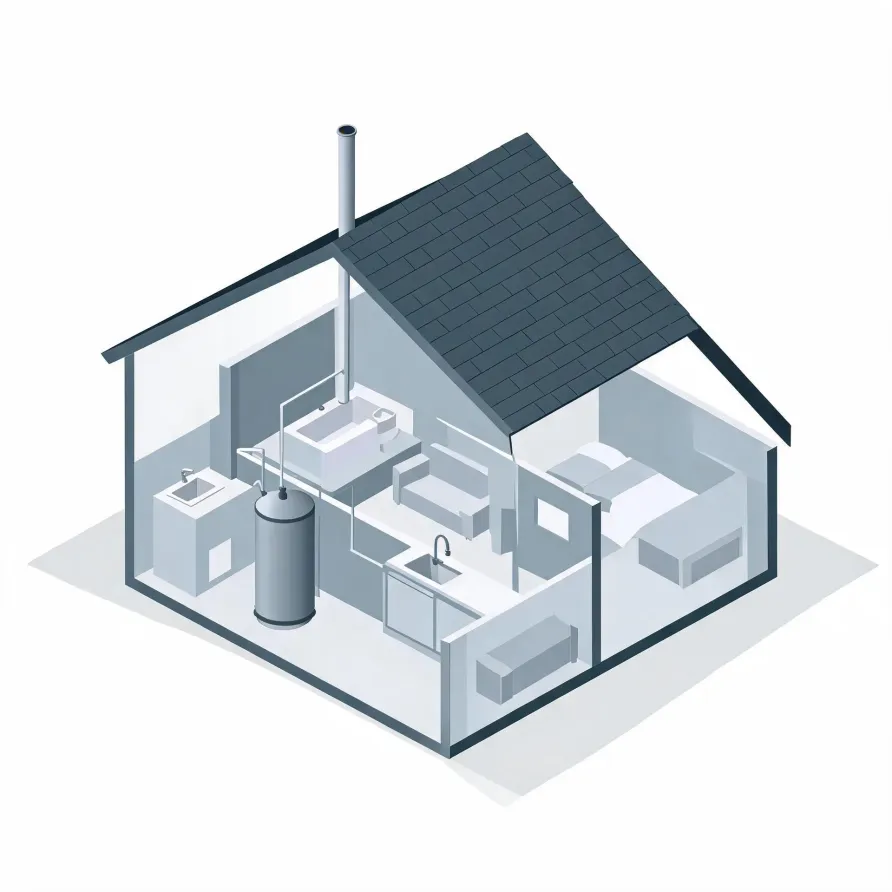
The tank is the piece most homeowners recognize, a large insulated cylinder that sits in a utility room, basement, or garage and holds the supply of hot water. Attached to it are the heating elements or burner assembly, which do the actual work of raising water temperature. When either fails, the water runs cold or never reaches the right heat.
The pressure relief valve mounts directly on the tank and releases if pressure inside builds too high. The anode rod runs down through the tank interior and slows internal corrosion. At the base or side, the drain valve, inlet and outlet connections, and the thermostat round out what a contractor works through when tracing a problem.
The drawing shows a general layout of these components, and a licensed contractor determines which parts apply and what condition they are in for your specific installation.
Get matched in Bergen CountyBergen County, NJ, by the numbers
246 severe weather events were recorded in Bergen County, New Jersey between 2015 and 2024.
NOAA National Centers for Environmental Information, Storm Events Database, bulk CSV export, events 2015-01-01 through 2024-12-31.Half the homes in Bergen County, New Jersey were built in 1960 or earlier (2020-2024 ACS 5-year).
U.S. Census Bureau, 2020-2024 American Community Survey 5-Year EstimatesBergen County, New Jersey holds 369,613 housing units (2020-2024 ACS 5-year).
U.S. Census Bureau, 2020-2024 American Community Survey 5-Year EstimatesOwners occupy 65.3% of the occupied homes in Bergen County, New Jersey (2020-2024 ACS 5-year).
U.S. Census Bureau, 2020-2024 American Community Survey 5-Year EstimatesCodes & Standards Governing Water Heater Repair in Bergen County, New Jersey2 sourced rules and standards
Licensing and Legal Requirements for HVAC Repair in Bergen County, New Jersey
In New Jersey the HVACR licence is the State's alone: a municipality, local board of health or any other agency may not issue or renew a Master HVACR contractor's licence.
New Jersey requires a Master HVACR contractor licence: no person or business may engage in the business of HVACR contracting, or advertise as a Master HVACR contractor, without being authorised under the State HVACR Contracting License Law.
Severe Weather Events in Bergen County
Extreme weather puts real stress on water heaters, from demand spikes during cold snaps to power fluctuations that wear down components. Bergen County's weather record shapes how hard local equipment works and how often it needs attention.
246 severe weather events, 2015–2024. Source: NOAA National Centers for Environmental Information, Storm Events Database.