Tell us about the job
Takes about a minute. No obligation.
Gas water heaters run every day of the year, not just through a heating season, which means the burner, thermocouple, and ignition components on a unit in this area take continuous cycling rather than months of rest. Utility gas heats more occupied homes in Cumberland County, New Jersey than any other fuel, at 64.8% (2020-2024 ACS 5-year). With gas so dominant here, contractors working a repair quote replacement parts for gas-specific components as a first step, since venting configuration and combustion air supply are already built around that fuel. A unit showing inconsistent heating or pilot failures almost always traces to the burner assembly or the thermocouple rather than the tank itself.
Half the homes in Cumberland County, New Jersey were built in 1969 or earlier (2020-2024 ACS 5-year). A water heater that has cycled through one or more replacements in a house this old often sits inside plumbing runs and venting arrangements that were built around something different. When a contractor opens the system, what they find in the connections, the venting path, and the condition of surrounding pipe decides how the repair goes and what parts it actually calls for. That reading cannot be done from the street.
The Parts of a Water Heater a Contractor Checks During a Repair
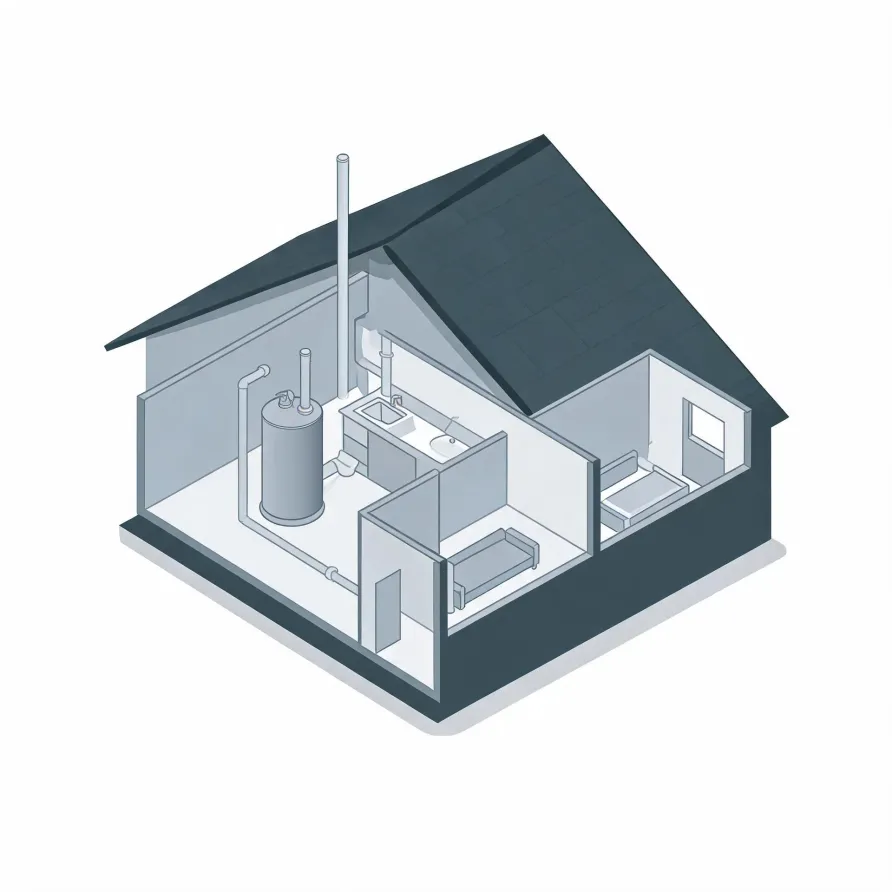
The tank is what most homeowners recognize: a tall insulated cylinder that sits in a utility room, basement, or garage closet and holds a supply of hot water ready for use. A heating element or burner assembly at the base or interior of the tank is where the actual heat comes from, and when output is weak or absent, that assembly is where a contractor looks first.
The thermostat controls the target temperature and tells the heating source when to fire and when to stop. A pressure relief valve sits on the side of the tank and opens if internal pressure climbs beyond a safe level. The anode rod runs down through the interior of the tank and slows corrosion from the inside out, and a worn rod often explains rust-colored water or a deteriorating tank wall.
The drawing shows a general cutaway of a water heater system, and a licensed contractor determines which components apply to the specific unit and installation in your home.
Get matched in Cumberland CountyCumberland County, by the numbers
105 severe weather events were recorded in Cumberland County, New Jersey between 2015 and 2024.
NOAA National Centers for Environmental Information, Storm Events Database, bulk CSV export, events 2015-01-01 through 2024-12-31.Half the homes in Cumberland County, New Jersey were built in 1969 or earlier (2020-2024 ACS 5-year).
U.S. Census Bureau, 2020-2024 American Community Survey 5-Year EstimatesCumberland County, New Jersey holds 57,282 housing units (2020-2024 ACS 5-year).
U.S. Census Bureau, 2020-2024 American Community Survey 5-Year EstimatesOwners occupy 66.5% of the occupied homes in Cumberland County, New Jersey (2020-2024 ACS 5-year).
U.S. Census Bureau, 2020-2024 American Community Survey 5-Year EstimatesCodes & Standards Governing Water Heater Repair in Cumberland County, New Jersey2 sourced rules and standards
What Cumberland County and New Jersey Require for HVAC Repair
In New Jersey the HVACR licence is the State's alone: a municipality, local board of health or any other agency may not issue or renew a Master HVACR contractor's licence.
New Jersey requires a Master HVACR contractor licence: no person or business may engage in the business of HVACR contracting, or advertise as a Master HVACR contractor, without being authorised under the State HVACR Contracting License Law.
Severe Weather Events in Cumberland County
Extreme weather puts stress on water heaters: demand spikes, power fluctuations, and temperature swings all push equipment harder. How often those conditions hit Cumberland County shapes what local water heaters face and how quickly problems develop.
105 severe weather events, 2015–2024. Source: NOAA National Centers for Environmental Information, Storm Events Database.